
God is NOT Fair | A Lesson From The Parable of the Vineyard Workers
You work extra hard, and you get promoted.
You study constantly, and you get better grades.
You train harder than everyone else, and you win sporting events.
That’s how planet Earth works:
You get what you deserve.
But when it comes to God, everything gets flipped upside down.
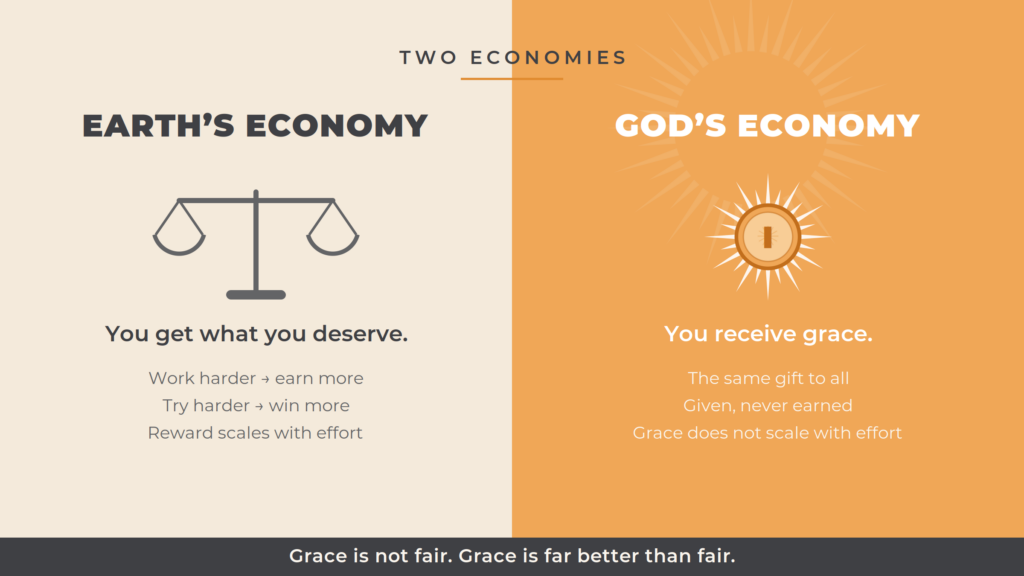
With God, you do not get what you work for.
You do not earn more because you try harder than someone else.
Instead, God gives all believers the exact same gift: eternal life in Christ.
An unbeliever can place their faith in Jesus at 10 years old or at 100 years old, and both inherit the very same salvation. One is not loved more. One is not forgiven more. One is not more saved than the other.
To the legalist, that sounds unacceptable. Human nature insists that the person who does more should receive more. But that is not God’s economy. God pours out His grace equally on all who believe.
“For God so loved the world that He gave His only begotten Son, that WHOEVER believes in Him shall not perish, but have everlasting life.”
There is no middle ground there. Whoever believes receives eternal life. Period.
The same principle applies to believers.
If one Christian gives 20% of their paycheck to the church, they do not receive greater spiritual blessings than the believer who gave 1%. If one believer struggles greatly with sin while another lives a more disciplined life, both are still fully forgiven in Christ. Both are loved equally. Both are heard equally by God. Both possess the same eternal inheritance.
There is a popular teaching that says if we work harder, sacrifice more, or perform better, God will reward us with greater heavenly rewards. But Scripture never speaks of believers receiving different “rewards” in eternity based on performance. Instead, Scripture consistently speaks of the reward — singular — and identifies that reward as our inheritance in Christ.
Colossians 3:24 says:
“Knowing that from the Lord you will receive the reward of the inheritance.”
The reward is the inheritance of the Kingdom itself.
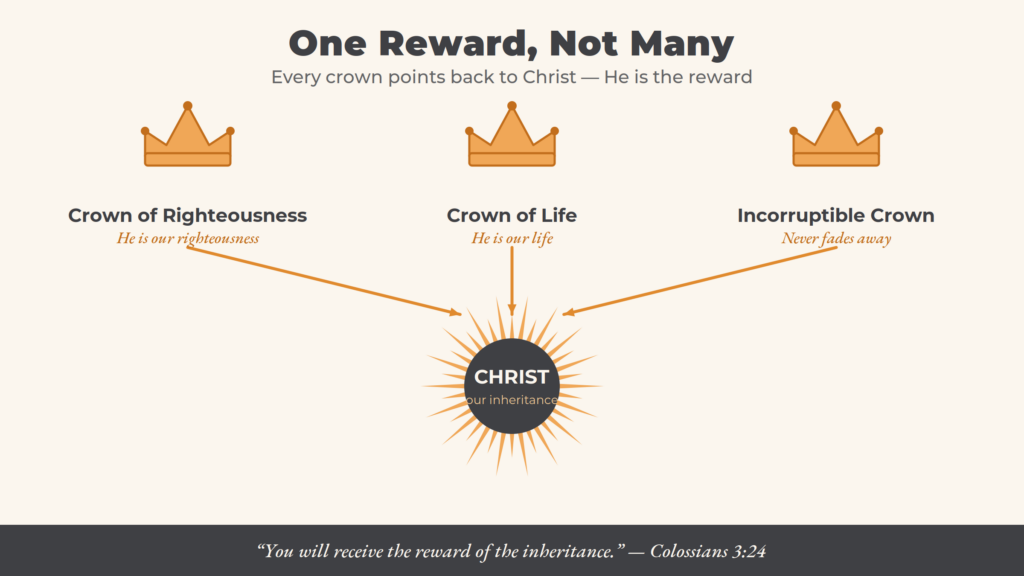
Even the crowns mentioned in Scripture are not trophies for spiritual competition. They point us back to Jesus Himself.
- The Crown of Righteousness — Jesus is our righteousness, and all believers are righteous in Him.
- The Crown of Life — Jesus is our life, and all believers possess life in Christ.
- The Incorruptible Crown — our inheritance is incorruptible, undefiled, and will never fade away.
None of us earn extra forgiveness.
None of us earn extra love.
None of us earn extra spiritual standing with God.
We are all treated the same because salvation is based entirely on grace.
From a human perspective, someone might say, “That’s not fair.” And they would be correct — at least according to human standards. Grace is not fair. Grace is far better than fair.
God’s love does not shrink when you make foolish choices. His grace is not reduced because you failed more than someone else. God forgives, blesses, and loves His children completely and fully because of Jesus — not because of human performance.
And when I speak of blessings, I am not talking about money, careers, success, or material possessions. In fact, 1 Timothy 6:5 warns against treating godliness as a means of financial gain.
I’m talking about spiritual blessings.
1 Corinthians 1:7 says believers “lack no spiritual gift.” In Christ, we already possess everything we need spiritually. Our effort does not increase what Christ has already fully provided.
Today, I thought it would be helpful to read the Parable of the Vineyard Workers and examine the lesson Jesus was teaching. The message is simple: God gives abundantly to all believers, and He is not measuring our worth by our effort, our failures, or how much we give.
God is good because He is good.
It really is that simple.
So let’s take a look at the Parable of the Vineyard Workers in Matthew 20:1–16.
“For the kingdom of heaven is like a landowner who went out early in the morning to hire workers for his vineyard. 2 He agreed to pay them a denarius for the day and sent them into his vineyard.
So, from the beginning, we are told by Jesus that He is comparing the kingdom of heaven to this land owner at the Vineyard. This landowner has just gone out and hired some workers, and he’s agreed to pay them a specific amount of money. A denarius.
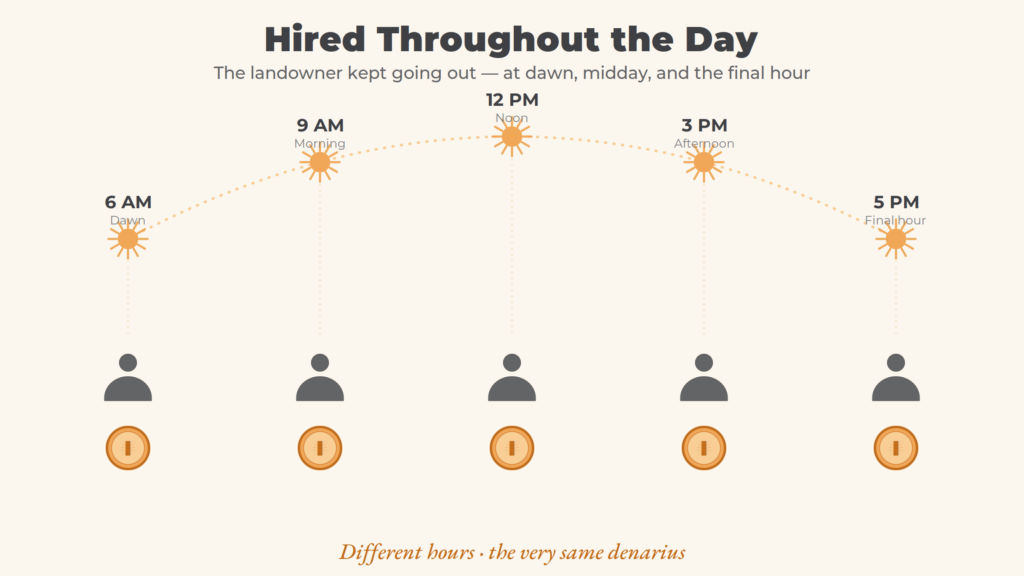
3 “About nine in the morning he went out and saw others standing in the marketplace doing nothing. 4 He told them, ‘You also go and work in my vineyard, and I will pay you whatever is right.’ 5 So they went.
I love that he says he’s going to pay them “whatever is right”. And here’s a little sneak preview of what’s going to happen. You’re going to find that your idea of what is right is not the same of Gods idea of what is right.
“He went out again about noon and about three in the afternoon and did the same thing.
The vineyard owner is still out there hiring more workers. Some are arriving late in the day, putting in only a fraction of the labor compared to those who came early that morning. Yet, in the end, they all receive the same return.
It’s a powerful picture of God’s grace. Some people come to faith when they are young and spend a lifetime serving, giving, and walking with God. Others may come to Him much later in life, with far fewer works and much less time to serve. Yet both receive the very same gift of eternal life.
That’s what makes grace so difficult for the legalistic mind to accept. We naturally think the one who worked longer should receive more. But salvation is not earned wages — it is an undeserved gift freely given by God.
6 About five in the afternoon he went out and found still others standing around. He asked them, ‘Why have you been standing here all day long doing nothing?’
It’s even later and the landowner is still out there bringing people in. It’s a picture of God continuing to bring people into the family. And even these late comers will get the full reward as the people who showed up first and did the most work.
7 “‘Because no one has hired us,’ they answered. “He said to them, ‘You also go and work in my vineyard.’
No one had hired them, yet the vineyard owner still invited them to come and work in the vineyard. This is a beautiful picture of humanity, including unbelievers. The invitation to enter the Kingdom is extended to all people. No one is forced to come, but the invitation is genuinely there for everyone.
And for just a moment, it’s important to recognize what Jesus is ultimately pointing us toward in this parable: an inheritance. Think about how an inheritance works. Do we earn it? Do we work for it? No. An inheritance is given because someone dies and leaves it to us.
That’s exactly the language Scripture uses regarding eternal life. Colossians tells us that the inheritance is the reward, and that reward is the Kingdom itself — eternal life with God. It is not something mankind earns through effort, merit, or years of works. It is something graciously given because of what Christ has done.
Now Jesus is about to reveal the shocking truth of this parable — that those who came late would receive the very same reward as those who labored all day.
8 “When evening came, the owner of the vineyard said to his foreman, ‘Call the workers and pay them their wages, beginning with the last ones hired and going on to the first.’
It’s fascinating that the landowner intentionally tells the foreman to begin with the workers who arrived last. These were the people who worked the least, worked the fewest hours, and from a human perspective, appeared to have contributed far less.
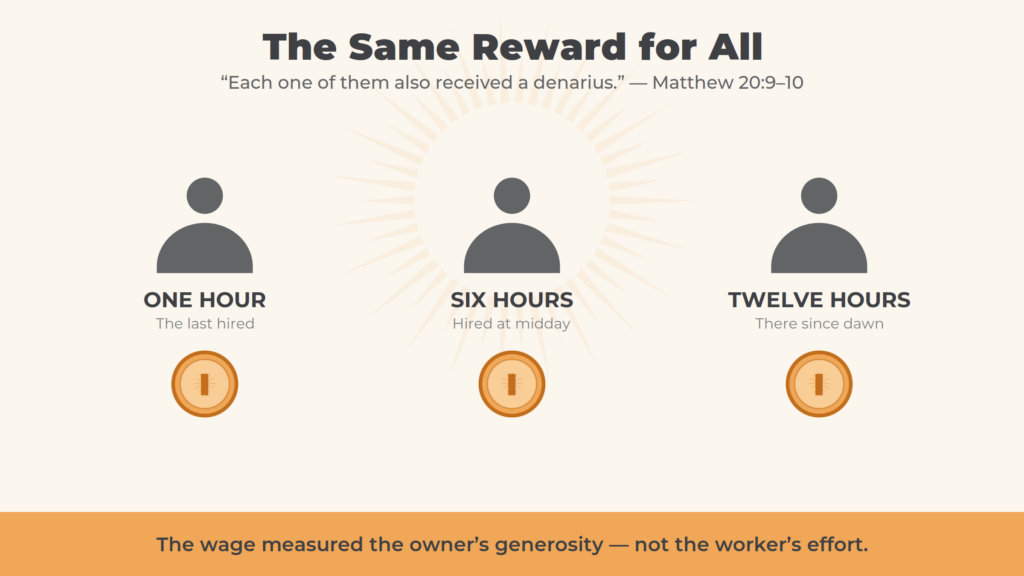
Yet we are about to see something shocking: the workers who came at the very end of the day still received a denarius — the exact same payment given to those who had worked from the very beginning.
And I would argue the point of the parable is not that the last workers were overpaid, but that the landowner is extraordinarily generous with what belongs to him. In fact, every worker was paid far more than they truly deserved. The emphasis is not on human effort, but on the generosity and grace of the owner.
That is how the Kingdom of God works. God does not deal with humanity on the basis of strict merit or performance. If He did, none of us would have anything to boast about. Instead, He pours out grace freely and abundantly, regardless of how long someone has worked or how much they appear to have accomplished.
9 “The workers who were hired about five in the afternoon came and each received a denarius. 10 So when those came who were hired first, they expected to receive more. But each one of them also received a denarius.
From a human perspective, that doesn’t seem fair. And this is exactly why legalistic thinking struggles so deeply with what Jesus is teaching here. Grace offends human pride because we naturally believe rewards should be based on performance.
The legalist believes the person who turns from the most sin, spends the most time reading the Bible, gives the most money, prays the longest, and performs the most works should receive more from God in return. In that mindset, God’s favor is earned through effort and maintained through performance.
But this parable completely destroys that way of thinking. The workers who labored all day received the same denarius as those who arrived at the very end. Why? Because the reward was never ultimately about human effort — it was about the generosity of the vineyard owner.
That is the scandal of grace. God does not offer eternal life as wages earned by human effort. He gives it as a gift. Legalism cannot fully embrace this because it always wants to leave room for human effort, human achievement, and human boasting. But the true Gospel leaves no room for that. Salvation is rooted entirely in the goodness, mercy, and grace of God, not in the performance of man.
11 When they received it, they began to grumble against the landowner. 12 ‘These who were hired last worked only one hour,’ they said, ‘and you have made them equal to us who have borne the burden of the work and the heat of the day.’
This reaction really is not much different from the mindset of a legalist today. In modern terms, it sounds like this:
“So you’re telling me that I gave 10% of my income to the church, served every week, read my Bible two hours a day, avoided all these sins, and tried my hardest to live faithfully… and I’m equal to the believer who barely served, never tithed, and hardly opened his Bible?”
That question exposes the heart of legalism. It reveals a person who believes their value before God is ultimately tied to their religious performance. Deep down, they believe they deserve more because they did more.
But the parable of the vineyard workers crushes that entire mindset. The landowner made them equal, not because their labor was equal, but because his generosity was equal. The reward was based on the goodness of the owner, not the merit of the workers.
That is exactly why grace is so offensive to human pride. The flesh always wants superiority, distinction, and recognition. It wants to believe that the harder worker deserves a greater standing before God. But Jesus teaches the opposite. Eternal life is not a trophy handed out to the most impressive religious performer. It is a gift given freely by a gracious God.
13 “But he answered one of them, ‘I am not being unfair to you, friend. Didn’t you agree to work for a denarius? 14 Take your pay and go. I want to give the one who was hired last the same as I gave you. 15 Don’t I have the right to do what I want with my own money? Or are you envious because I am generous?’
The owner was not mistreating the workers who showed up first. They received exactly what they had agreed to. The issue was not injustice — it was generosity. The landowner simply chose to be equally kind to the people who came later.
That is the heart of this parable. The owner is using his own resources to bless people, regardless of how much labor they contributed. The problem for the early workers was not that they were treated badly, but that they could not stand seeing others receive the same grace they did.
And honestly, that mirrors the mindset of legalism today. Legalists constantly tell people that if they do more, sacrifice more, give more money, serve more, pray more, and fight harder against sin, then God will reward them more favorably. They believe God’s blessings are distributed according to human performance.
So if someone is not tithing enough, not serving enough, or not showing enough outward repentance, the legalist assumes that person must receive less from God. Why? Because they are viewing everything through man’s economy: you get what you earn. To the human mind, that feels fair.
But Jesus is teaching us that God’s Kingdom does not operate according to human merit. God is not merely “fair.” If God dealt with us strictly according to fairness, every one of us would stand condemned. Instead, God is exceedingly merciful, overwhelmingly generous, and full of grace.
He gives forgiveness, eternal life, and spiritual blessings not because we are impressive, but because Jesus is. The reward is rooted in the goodness of Christ, not the performance of man.

16 “So the last will be first, and the first will be last.”
I believe this is also a picture of the relationship between the Jewish people and the Gentiles. Israel was invited first. They were given the Law, the covenants, the promises, and the knowledge of the true God long before the Gentiles were brought in.
Then later came us — the Gentiles. Spiritually speaking, we were standing out in the field with nothing to offer, not pursuing righteousness under the Mosaic Law, and yet God still extended the invitation to us. We were the ones who came last. We did the least. And yet, through Christ, we are welcomed fully into the Kingdom.
That completely shatters the idea that salvation is about human performance or religious achievement. It was never about how well someone kept the Mosaic Law, how disciplined they were, or how impressive their works appeared outwardly.
The entire point is Jesus.
Jesus is the reason anyone enters the Kingdom.
Jesus is the reason anyone receives the inheritance.
Jesus is the reason the last can become first.
The Kingdom of God is not built on human merit, but on divine grace.

Author: Mike Cynar
Mike Cynar was raised in a church setting where he frequently noticed that many attendees would eventually drift away. The church labeled these individuals as ‘back sliders’ or ‘fake Christians’ just looking for ‘fire insurance’. However, Mike realized the issue was rarely with these individuals but instead with the church’s message itself. The teachings heavily emphasized behavior improvement and one’s flaws, with only a fleeting mention of one’s identity in Christ. It felt as though every sermon was tailored to the church of Corinth, who as we know or committing sins that even unbelievers don’t partake in. This trend was noticeable not just in one denomination, but across Baptist, Catholic, Pentecostal, and many other churches. Upon understanding the true essence of the gospel – that our righteousness comes from Jesus’ actions, not our own – Mike was inspired to liberate believers from lifeless sermons and reconnect them with the genuine teachings of Jesus. He believes that one can nurture a vibrant and growing bond with Jesus, unhindered by rigid religious practices. And thus, “Jesus Without Religion” was born.
It turns out that it is grace that leads to repentance. And if our heart is to get others to walk in the Spirit and live a godly life, then the best approach is not a beat down sermon, but rather to remind other that it is only when we understand our true identity in Christ that we will live it out. Yes, it’s true, if you’re convinced that God thinks you’re a dirty sinner, you will ultimately continue a lifestyle that mirrors that view, but if you truly believe that even on your worst day, you are called holy, sanctified, justified, and will be presented blameless in the end, well, it turns out this is the secret to living out on the outside what has been worked in to the inside.